
What Is a Multi-Outcome Market?
Last updated: July 8, 2026
A multi-outcome market is a prediction market with more than two possible results, like “Who will win the World Cup?”
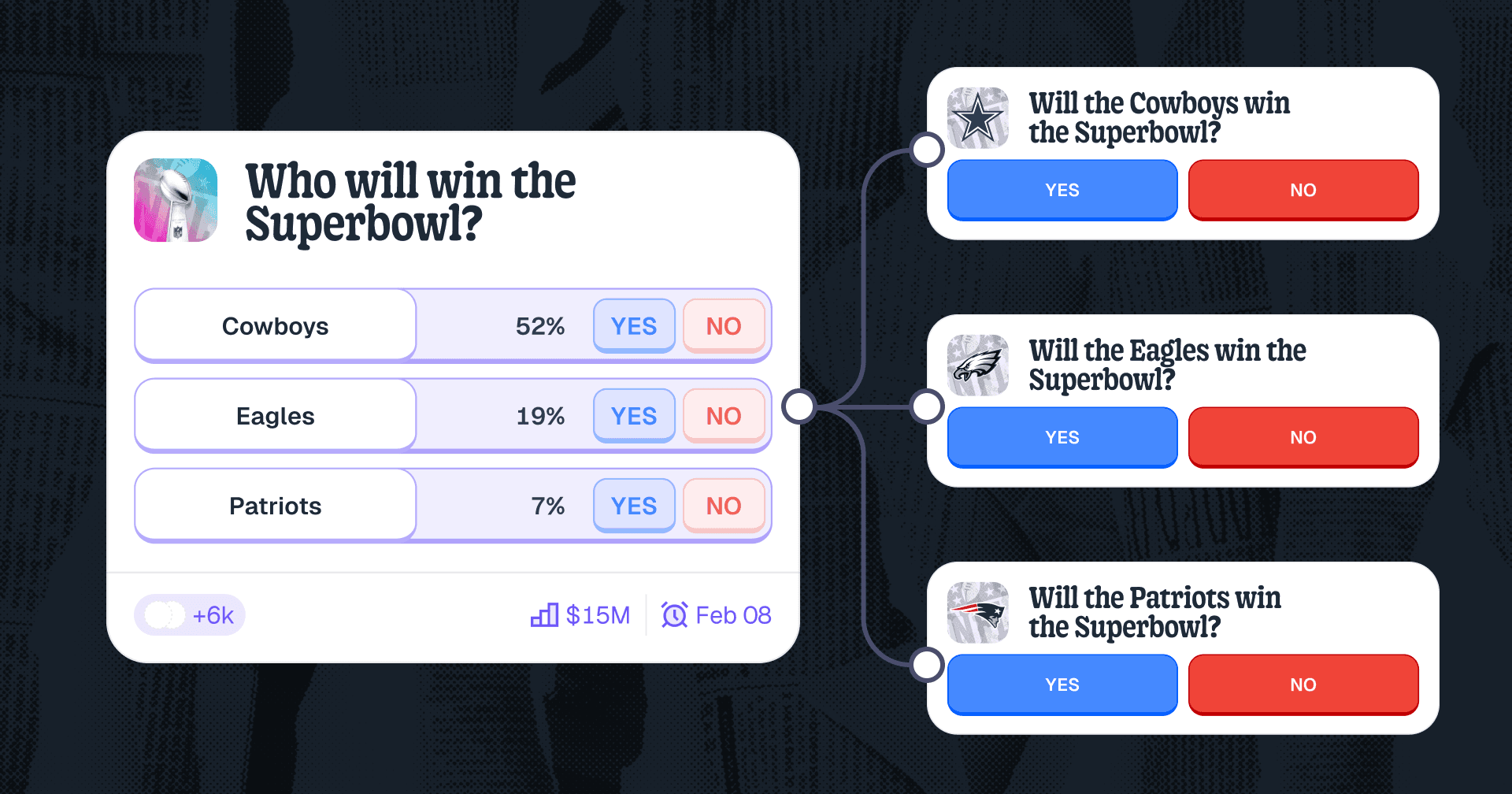
Under the hood, it’s a bundle of binary YES/NO markets, one per outcome, grouped under a single question.
The prices of all outcomes sum to roughly $1, because together they represent 100% of the probability.
Multi-outcome markets unlock strategies binary markets can’t express, like buying several outcomes at once or trading against the favorite.
Beyond YES and NO
Most prediction markets ask a question with two answers. Will the Fed cut rates in September? Will Bitcoin close the year above $150,000? YES or NO, one or the other.
But plenty of real-world questions don’t come in twos. Who will win the World Cup? Which party takes the Senate? Which film wins Best Picture? These questions have many possible answers, and forcing them into a single YES/NO frame would throw away most of the picture.
That’s what a multi-outcome market is for: a single market page where every possible answer is listed, priced, and tradable side by side.
How Do Multi-Outcome Markets Work?
Here’s the secret: a multi-outcome market is still just YES/NO markets. It’s a bundle of them, grouped under one umbrella question.
Take a Who will win the World Cup? market. Spain, France, and Brazil aren’t three options within one market—each is its own binary market:
- Will Spain win the World Cup? YES / NO
- Will France win the World Cup? YES / NO
- Will Brazil win the World Cup? YES / NO
When you buy Spain at 24¢, you’re buying YES shares in the Will Spain win? market at $0.24. If Spain lifts the trophy, each share redeems for $1. If any other team wins, Spain’s YES shares go to $0, and the YES shares in that team’s market redeem instead.
Exactly one outcome resolves YES. Every other outcome resolves NO. That constraint is what gives multi-outcome markets their most useful property.
Why Do Prices Sum to $1?
In a binary market, YES and NO always add up to $1, because one of them must happen.
The same logic scales up. In a multi-outcome market, exactly one outcome will occur, so the YES prices across all outcomes sum to roughly $1—the full 100% of probability, split across the field.
A simplified World Cup market might look like this:
| Outcome | Price | Implied probability |
|---|---|---|
| Spain | $0.24 | 24% |
| France | $0.19 | 19% |
| Brazil | $0.16 | 16% |
| England | $0.12 | 12% |
| All others | $0.29 | 29% |
Read down the price column and you’re reading a live probability distribution. That’s the real power of the format: one glance tells you how the market weighs every contender, not just whether a single outcome clears 50%.
If the prices ever summed to meaningfully more or less than $1, traders would arbitrage the gap away, buying the underpriced side until the numbers realign. Liquid multi-outcome markets are self-correcting in this way.
What Can You Do With Multi-Outcome Markets?
Because every outcome is independently tradable, multi-outcome markets support strategies that binary markets can’t express.
Buy more than one outcome. Think the winner comes from Europe? Buy YES on Spain, France, and England together. Your position redeems if any of them wins, and the combined cost tells you exactly what the market thinks of your thesis (55¢, in the table above).
Trade against the favorite without picking a winner. Convinced Spain is overpriced at 24¢ but no view on who wins instead? Buy NO on Spain. You profit if any other team lifts the trophy, and you never had to choose which one.
Trade the shape, not the answer. News moves probabilities long before resolution. If France’s star striker gets injured in the group stage, France’s YES price drops and the rest of the field rises. You can trade that repricing without holding anything to expiry.
Note: buying YES on every outcome guarantees a $1 redemption, but it also costs roughly $1. There’s no free lunch in a well-priced market. The edge comes from knowing which outcomes are mispriced, not from buying all of them.
Multi-Outcome Markets on Predict
Predict, the top prediction market on BNB Chain, supports multi-outcome markets natively: all outcomes on one page, one order book per outcome, priced side by side. Not every platform does. Some list only binary markets, leaving you to hunt down each Will X win? market separately and assemble the picture yourself.
This is also where Predict’s capital-efficient design matters most. In a crowded field, most outcomes trade low and stay low for months. A World Cup market opens long before the final, and capital committed to it would normally sit idle that whole time. On Predict, the collateral backing your open positions earns yield via Venus Protocol while you wait—which counts for the most in exactly these long-running, many-outcome markets.
Ready to Make Your First Prediction?
Join thousands of traders making smarter predictions every day.
Let's GoFrequently Asked Questions
How is a multi-outcome market different from a binary market?
A binary market has two outcomes, YES and NO. A multi-outcome market groups several binary markets under one question, so every possible answer is priced and tradable side by side, and exactly one resolves YES.
Is a multi-outcome market riskier than a binary market?
Not inherently. Each outcome is a binary market with the same mechanics: shares cost between $0 and $1 and redeem for $1 or nothing. The risk profile depends on the prices you pay, not the number of outcomes. Shares at 3¢ exist in binary markets too.
What happens if none of the listed outcomes occurs?
Well-constructed multi-outcome markets are exhaustive, usually via a catch-all outcome like “All others” or “Any other candidate”. That guarantees exactly one outcome resolves YES. Always check a market’s resolution rules before trading.
Can I sell my shares before the market resolves?
Yes. Every outcome has its own order book, so you can exit any position at the current market price whenever there’s a counterparty, just as in a binary market.
Why don’t the prices sum to exactly $1?
Spreads and liquidity. Each outcome’s price comes from its own order book, so small gaps appear between them. In liquid markets, arbitrage keeps the total within a cent or two of $1.
Multi-Outcome Market Glossary
Multi-outcome market
A prediction market with more than two possible results, structured as a group of binary YES/NO markets where exactly one outcome resolves YES.
Binary market
A market with two outcomes, YES and NO. The building block of every multi-outcome market.
Implied probability
The probability of an outcome as expressed by its share price. A YES share trading at $0.24 implies a 24% chance.
Catch-all outcome
A residual outcome (such as “All others”) that covers every result not individually listed, ensuring the market always has a winner.
Arbitrage
Trading that profits from price inconsistencies, such as a market’s outcomes summing to more or less than $1. Arbitrage pressure keeps prices aligned with probabilities.
Continue Learning
BASICS
What Is a Prediction Market?
Understand how YES/NO contracts work, what price movements actually mean, and why market prices reflect real-time probabilities.
BASICS
What Are Bond Markets?
Near-certain-outcome markets where NO shares trade at $0.98–$0.99 — how the 1–2% return works, and why it isn’t risk-free.
BASICS
How Yield Works on Open Positions
Open positions on Predict's yield-bearing markets earn yield via Venus Protocol instead of sitting idle — how the rate is set, how to claim it, and what to watch for.
BASICS
How Prediction Market Fees Work
Prediction market fees explained: gasless trading, how the taker fee is calculated, maker rebates and invite discounts, and what deposits, withdrawals, and yield actually cost.
BASICS
What Is a Predict Smart Wallet?
No seed phrase, no gas fees on approvals or withdrawals. How the wallet created on signup actually works, who controls it, and when connecting your own wallet makes sense.
GUIDE
How UMA's Optimistic Oracle Powers Prediction Market Resolutions
A deep dive into the oracle infrastructure that settles prediction market outcomes — automatically, on-chain, without any central authority.
COMPARISON
Predict vs Polymarket
Yield on open positions, BNB Chain, smoother onboarding — here's how Predict stacks up against the biggest prediction market in the world.